
February 12, 2014 · DNA
Goal Posts
What are your goals?
If you've been training for a while, sticking to your nutrition plan and seeing good results, but are starting to plateau on strength or just want to spice things up, goal-setting can be a great way to focus your efforts. DNA's programming is built on cycles designed to make you progressively stronger over time, but it still helps to have targets to aim for to keep you motivated. Excelling at many things at once is very tough to do: people who win triathlons are rarely the fastest swimmer, cyclist or runner, but they're darn good at all three events. All-around strength is fantastic for quality of life, but sometimes having a specific achievement in your sights is the best way to push yourself to the next level.
 A folding ITSA GOAL from Sheffield
Goal areas
You can set goals in any area of your life, but we're going to focus on your body. At DNA, many clients have a body fat goal. To attain 9% for guys or 15% for women, for example, much dedication to both nutrition and training is required, but the goal can help you stay on track when confronted with chocolate cake or a tall cold one. Your choice has context: you can indulge and enjoy, but you will take a step back from your goal.
Strength goals are easy to set. You can choose a lift that you love or hate, at which you excel or struggle. Time goals are great too: Fran time, 1-mile run time, 30 man-makers — all will work. Competition is great too. If you want to deadlift more than your spouse, for example, you have a goal!
Goal setting
I learned the SMART goal-setting framework in the corporate world. It works well in the gym too.
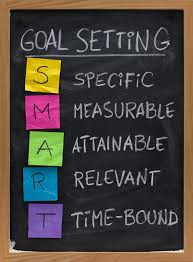 Make your goals SMART!
Specific: just what it says. A 300 lb deadlift is a specific goal. "Get stronger" is not. State it clearly and own it!
Measurable: quantify — body fat percentage, run time, lift weight. Your goal should be something you can describe objectively, preferably with a number. Yes/no also works, as in "successful strict unassisted pull-up."
Attainable: start from where you are now, and pick something you can realistically achieve. If your one-rep max squat is 120 lb, then 250 lb is not a very good goal (for now, anyway). 150 lb is a better choice. When you get there, you can pick a new goal!
Relevant: each goal should be relevant to your overall direction. If you want to get stronger, a deadlift goal is a great idea. If you want to build muscle mass, a fast 5K run is not the best choice.
Time-bound: self-explanatory. Time frames of a few months are generally better for motivation than longer ones, and shorter ones are sensitive to bumps in the road. For example, if I can do a 35 lb Turkish get-up, setting a goal to lift the 53 lb bell in 2 months is achievable but requires that I do everything right. If I have a business trip in the middle of those 2 months, the goal may become unachievable. A longer timeline of 3 months gives me wiggle room, and if I get there faster, then great!
What are your goals?
Pick a few goals — 2 or 3 will suffice — and write them in your logbook. Challenge yourself! You can work on your weak areas or build your strong ones; it's up to you, but I like a mix. For example, it took me a long time to break 300 lb on my deadlift, and I worked on it for at least a year; I could aim for 325 lb by July. However, I'm more interested in working on my push-ups at this point, aiming for a one-arm push-up by July. I'm on Step 6 of 10 of Paul Wade's Convict Conditioning push-up progression, building on a strength, and drilling my close push-ups a few days each week. I'm also on Step 2 of the handstand push-up progression, which is a weak area for me, so I'm giving myself more time to get to a HSPU (September). Both goals are specific, measurable (can I do a one-arm push-up and a handstand push-up, or not?), attainable (!), relevant (working on overall strength and specifically getting better at bodyweight exercises), and time-bound.
Will I get there? Yes! I've achieved SMART goals before — a 70 lb KB snatch, a 300 lb deadlift, a 200 lb squat — and I'll do it again.
Will I have to work? YES!
Are these goals motivating and helpful in focusing my efforts? YES!
Write your goals, and if you need help devising a plan, talk to your trainer. We'll help you get going!