
February 10, 2013 · Lifestyle · Meals
Laissez les bons temps rouler! It's Mardi Gras!
One of my favorite holidays is Mardi Gras. I met my husband at a Mardi Gras party (in my squadron, surrounded by fighter pilots, including my boss who was making hurricanes), and I just love the idea of an all-out city-wide no-rules party. In addition to beads (um, the beads are great but the associated activities aren't really my thing) and the parades, the FOOD from the Big Easy is great — spicy comfort food... what's not to love?
Well, the grains involved! Unfortunately, beignets are not in the nutrition plan, though the chicory coffee is still good to go. If you are eating rice, gumbo and jambalaya are still a go, without corn. If you aren't eating rice, you can approximate with cauliflower rice. PaleOMG has a good recipe here for pork, shrimp, and chicken sausage gumbo. Note: they forgot the okra!
 YUMbo!!
What about the legendary beverages of New Orleans, particularly Hurricanes? Alcohol is a toxin and it gets in front of the other macros in the digestion line, so if you're going to drink, it's a cheat day — and don't whine if your performance is off afterwards. Enjoy and don't feel guilty (assuming you are not swilling passion fruit juice with rum on a regular basis!).
Another Mardi Gras favorite is the King Cake. You can read about King Cakes here — they are essentially huge cinnamon rolls, or other stuffed bread/cakes, with a plastic baby (or marble) hidden inside, iced with purple, green, and yellow frosting and sugar. King Cakes are also not in your macros! The story is that whoever finds the baby in their slice of King Cake gets good luck, or gets to buy the next King Cake, or gets to wash the dishes, depending on who you ask.
 Traditional King Cake, accessorized
While I do not pretend that "paleo" baked goods are anything that a caveman would have found or eaten — the concentrations of sugars, nuts, etc. are too high — most of the almond flour and coconut flour recipes on the web are at least made with real food. These "paleo" baked treats, including this one, are once-in-a-while indulgences for holidays and special occasions, not something you want to keep on hand all the time. Their advantage is that the absence of refined sugars and wheat flours makes them less offensive to your system, so you shouldn't experience the same stomachache, headache, sugar rush, etc. that you might get from a conventional baked good, and your body should be able to process them more efficiently.
In this spirit, I present the following King Cake approximation recipe. It's a vanilla cake, rather than a cinnamon roll (my cinnamon roll recipe has a lot of palm sugar in the filling), and I baked in a marble instead of the plastic baby. Incidentally, I still have the baby from the 1999 Mardi Gras party where I met Rick. I guess it works! — AJ
"PALEO" KING CAKE
Part 1: THE CAKE
Option A: Adapted from Perfect Vanilla Cake
Preheat oven to 350°F.
8 eggs
1 1/2 cups coconut milk (canned) or cream
1 1/2 tbsp vanilla extract
1 cup palm sugar (or other natural sweetener; 3/4 cup agave or maple syrup will work, but they're sugary) — I buy my palm sugar from Amazon
1 cup blanched almond flour
1 cup coconut flour
1/2 teaspoon unrefined sea salt
Scant 1 teaspoon baking soda
1 tbsp cinnamon (or more if you like)
Stevia if more sweetness is desired
Note on sweetener amount: you can further reduce the sugar and use more stevia, but it's better with at least a little of some type of real sugar, since sugar contributes to a good crumb texture. Stevia is a dried plant; Splenda and Sweet 'n' Low come from a lab, so we don't recommend those.
In a large bowl, whisk together the eggs, coconut milk, vanilla extract, and palm sugar.
In a smaller bowl, combine the almond flour, coconut flour, salt, and baking soda.
Mix the dry ingredients into the wet with a handheld mixer. Add stevia to taste.
Grease a bundt pan or angel food pan (or another cake pan if you don't have a round one with a hole in the middle) with melted coconut oil or butter, and pour in the batter.
Bake for 45–50 minutes, until a knife inserted comes out clean.
Cool for 1 hour.
You can bake a non-melting item like a glass marble into the cake, or push a plastic baby or other small trinket into the cake AFTER baking, before turning it out of the pan. No melted plastic babies, please... that's a buzzkill.
Option B: make a cinnamon roll and connect the ends. Cinnamon roll recipe:
Dough: mix the first three ingredients, then mix in the rest. Roll into a long rectangle, about 1/4–1/2" thick.
2 eggs
1 tbsp maple syrup or honey
1/4 cup ghee or coconut oil (melted)
2 1/2 cups almond flour
1/2 tsp sea salt
1/2 tsp baking soda
Filling: mix 2 tbsp melted ghee, butter, or coconut oil, 2 tbsp cinnamon, and 3 tbsp palm sugar. Spread all over the dough rectangle, and then carefully roll up the rectangle to make a long cinnamon roll snake. Connect the ends to make a donut shape, and bake for 25 minutes in a 350°F oven.
Option A produces a more spongy, soft cake; Option B is more authentic, but a little denser and less soft. Hey, I told you this recipe is an approximation!
Part 2: THE ICING — marshmallow frosting, adapted from Elana Amsterdam's recipes. You could also use her coconut cream frosting recipe (probably half of it, not the whole thing), but it's a bit more work and requires a lot of some expensive ingredients.
1/2 cup agave nectar (high in fructose and not the best choice, but honey makes it too sickly sweet and the flavor is off — I tried it)
2 egg whites
In a small saucepan over medium heat, bring the agave nectar to a boil, stirring frequently. Decrease the heat to low and simmer for 4 to 8 minutes, watching constantly and stirring occasionally, until the agave darkens slightly from its original color.
In a large bowl, whip the egg whites to stiff peaks. Drizzle the agave slowly into the egg whites, whisking continuously until blended. Divide into 3 bowls, color one purple, one yellow, and one green, and ice the cooled cake.
Surround with beads, masks, etc. and call your friends over to share!
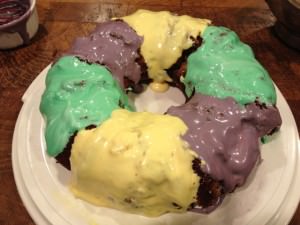 AJ's King Cake, minus the beads and feathers